Having recently had the opportunity to reflect on my academic journey to date, as part of my PhD application, I thought of writing this post to document how I ended up in this niche field of system dynamics. If you told 20-year-old me that I was going to end up building and analysing quantitative computational models, I would have gawked at you and probably thrown up a little in my mouth.
For the love of social sciences
I have always been a social science guy. As a teenager in secondary school, I quickly learnt that I had an aptitude for subjects related to the social sciences and humanities. By the time I attended Junior College (pre-university education in Singapore), opting for the “Arts stream” over the “Science stream” was an absolute no-brainer.
I truly fell in love with the social sciences and social research, during my undergrad days at the Faculty of Arts and Social Sciences, National University of Singapore. The beautiful thing about the faculty is that the first year is a free-for-all buffet of courses across all the disciplines they had to offer. Eventually, I opted to double-major in Global Studies and Political Science. I chose Global Studies as my primary major since it was an inter- and multi-disciplinary programme that allowed me to continue taking courses from a multitude of disciplines, including political science, sociology, communications, history, and various area studies. The knowledge we gained in various disciplines then became the foundation for our interdisciplinary core courses which focused on tackling global and transnational political-social-economic governance problems. I truly felt at home with my programme, excelled at it, and graduated summa cum laude!
Although I was trained in both quantitative (statistics and regression) and qualitative research methods, I was always more comfortable with qualitative research. I became enamoured by critical theory and poststructuralism, which led to me to apply (Foucauldian) discourse analysis on queer international human rights for my honours thesis. I also had to do an honours capstone group project, known as Task Force. For that, we studied intimate partner violence in Singapore from a global studies perspective – interpreting the local issue under the light of international governance regimes. Here, we also applied qualitative social research methods by interviewing local individuals and organisations. Ultimately, the report focused on policy recommendations for closing the protection gaps for vulnerable and marginalised groups in society.
Basic to applied social research
By this point, it should be quite obvious that I was especially interested in issues faced by marginalised communities. Partly, my interest was piqued by my experience at Chua Thian Poh Community Leadership Centre, National University of Singapore as an undergrad student research fellow. There, I was exposed to asset-based community development and applied social research. As research fellows, we conducted social research for local organisations. I partnered with PAVE Singapore (violence specialist NGO) to study the awareness and attitudes towards dating violence amongst young people. Later, I was part of a collaborative research team that mapped multicultural, low-income residential areas in Singapore for supporting Beyond Social Services’ community development efforts. It was during this time when I began to truly appreciate community-based applied research. It gave me a sense of purpose and made me feel like I was truly part of the solution to social problems at the ground level.
Soon after graduating, I took up a full-time position as the Research & Advocacy Executive at Action for AIDS (AFA) Singapore, a community-based non-profit organisation working to eradicate HIV/AIDS and promote sexual health well-being. At AFA, we worked closely with marginalised communities in Singapore to provide education, counselling and other prevention services. While working, I never stopped learning. My sister, who was involved in community-based system dynamics at Washington University in St. Louis as part of her master’s in social work degree, introduced systems thinking and Donella Meadows to me. Reading “Thinking in Systems” triggered a paradigm shift in my worldview. I came to realise how my work at AFA was trapped in designing intervention programmes that focused on stop-gap solutions to treat symptoms, short of fundamental solutions. Also, at that time, AFA was drafting a Community Blueprint to end HIV/AIDS in Singapore by 2030 with 30 stakeholder organisations. Briefly, the blueprint outlines the key issues and recommends intervention programmes in relation to at-risk demographic populations, HIV-related stigma and discrimination, HIV/AIDS service providers, as well as prevention programmes. Here’s the problem with my new-found system thinking brain: I was not comfortable with the fact that it was being drafted based off the linear cause-effect mental models of the various stakeholders and their respective silos.
I began to see, in my head, how a system dynamics model of the various interdependent variables within the HIV/AIDS social system could actually test the various recommendations from the blueprint. Doing so could help focus efforts on high-leverage policies and anticipate plausible unintended consequences. I knew what could be done, I just didn’t have the skillset to do it myself! This realisation eventually led me to search for a master’s programme in system dynamics. And that’s how I ended up at the System Dynamics Group, University of Bergen in Norway.
Becoming a system dynamics modeller
The system dynamics programme at UiB was no joke! The first semester was very intensive with a very steep learning curve. Here’s the thing, I wasn’t prepared for how quantitatively challenging it was going to be. I called my sister and chided her for giving me false reassurance that the math involved was manageable. I started browsing YouTube videos for a refresher on calculus and differential equations; at that time, it had been a decade since I had to do any math at all! But with the benefit of hindsight, my sister was right. The math involved really is manageable! The beautiful thing about system dynamics diagramming is that it’s a very transparent approach to mathematical modelling. Every single variable in the model has a real-world equivalent and they have actual names that makes sense. We also do not hide variables or parameters in equations. Modelling, in my opinion, really boils down to three things: (1) logic, (2) conceptual thinking, and (3) time/experience. The bottom line is that it takes time for it to click and, when it does, it’s brilliant!
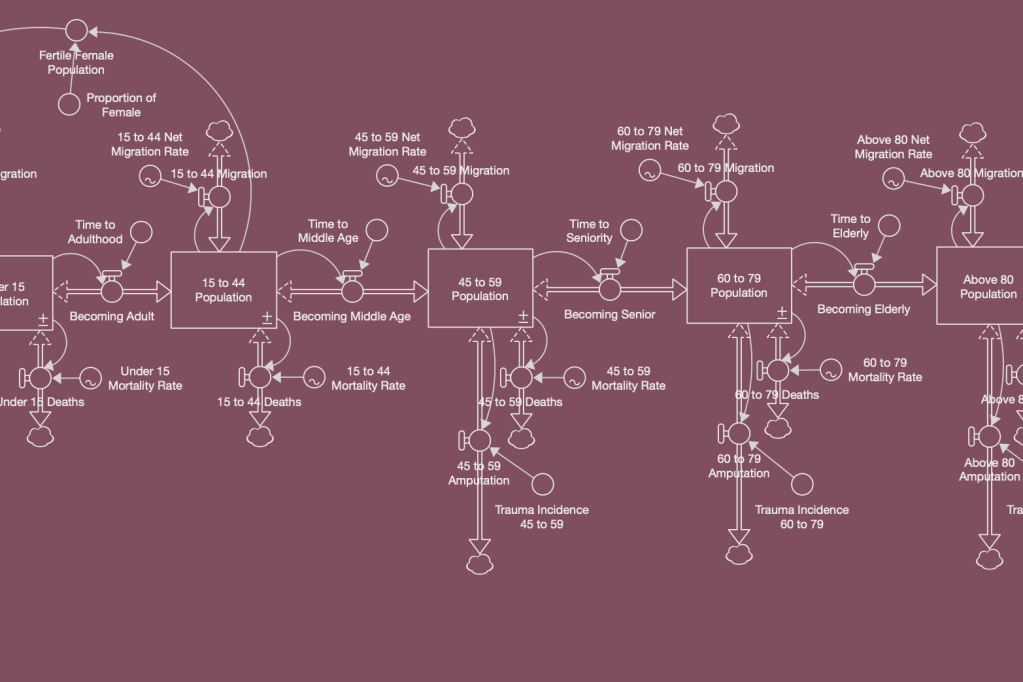
Once I got the hang of modelling, I became interested in bridging applied social research with system dynamics. This meant I was more interested in ‘soft’ modelling that involved people and their decision-rules. The first ever model I built independently, as part of my course work, was a ‘soft’ model on the psycho-social system surrounding the dynamics of individual passion burnout and turnover intention. I presented this model at a parallel session on human behaviour at the International System Dynamics Conference (ISDC) 2021. In the following year, at a parallel session on environment, I presented my model on South Australia’s agri-food system. Here, the focus was on the demand-side impacts of food literacy education programmes and value shifts in the social system on local farmers’ livelihoods. For my master’s thesis, I worked with ProsFit Technologies to model the health and prosthetics care system for major lower-limb amputees. I was drawn to this collaboration because ProsFit was co-founded by a double amputee and they are truly driven to improve the quality of life for amputees. My model sought to assess the potential impact of scaling up digital prosthetics services on amputee mobility, and the socio-economic benefits of such mobility. We later published my thesis as a journal article.
I also made it a priority to develop competency in participatory modelling, given my passion for community-based research. At UiB, our main focus is on quantitative modelling. This meant that there weren’t courses dedicated to the more qualitative Group Model Building (GMB) method. So, I opted to take a self-directed special topics course on GMB with Christina Gkini, a PhD Candidate. We designed GMB workshops and explored the micro-level meaning-making processes inherent in stakeholder interactions to open up the black-box of participation. We presented our findings from this research at the ISDC 2022 in Frankfurt, Germany. I also involved myself in participatory modelling opportunities from the department whenever it came up. I have conducted several systems mapping workshops on topics such as adolescent obesity, sustainable development goals, and groundwater depletion. Notably, I consulted for the Transboundary Groundwater Resilience Network of Networks to design, facilitate and evaluate a systems mapping sessions at their Annual Workshop.
When the System Dynamics Group received funding for a PhD position as part of the EU Horizon project, WorldTrans, I was beyond overjoyed. This position was perfect for me in the sense that it was heavily focused on participatory modelling and also involved simulation modelling. The premise of the EU project is that existing integrated assessment models for climate change mitigation suffers from several weaknesses. For me, the most important of those weaknesses is the inadequate representation of human behaviour within the social system. The PhD position, which I eventually was hired for, seeks to include social and cultural factors that influence behaviour in integrated models. I am also tasked with designing and executing participatory modelling workshops to meaningfully include stakeholders (experts and citizens alike) in the practice of integrated assessment modelling. I’m truly excited to start on this project and I believe it embodies what I have come to adopt as my personal tagline for my career:
system dynamics in practice, social research at heart
Jefferson K. Rajah
 Jefferson K. Rajah
Leave a comment